Single crystals matter because their highly ordered molecular structure can improve conductivity and enhance how the material responds to light, both key factors in the group’s work on photophysics and potential solar energy applications.
It didn’t turn out how King hoped, but the end result was still valuable.
“I guess long story short, the project didn’t work,” he said. “But I definitely learned a lot on that project — how to plan experiments and how to critically analyze what I’m doing so that I can actually say that it didn’t work. It’s really important to be able to say, ‘I’ve done everything I think I can, it’s time to pivot.’”
Last summer King was awarded a Summer Undergraduate Research Experience (SURE) scholarship to continue his work in Ostroverhova’s lab. This program pays students to complete 10 weeks of full-time research during the summer.
"It was an amazing opportunity because it let me dive down into this and learn a lot of lessons you need to know as a scientist."
“If I needed to have another job to fill those 40 hours a week I would have gotten very little research done,” he said. “Having something like SURE is really important because it really lets you spend a lot of time doing research and developing your skills as a researcher. It was an amazing opportunity because it let me dive down into this and learn a lot of lessons you need to know as a scientist.”
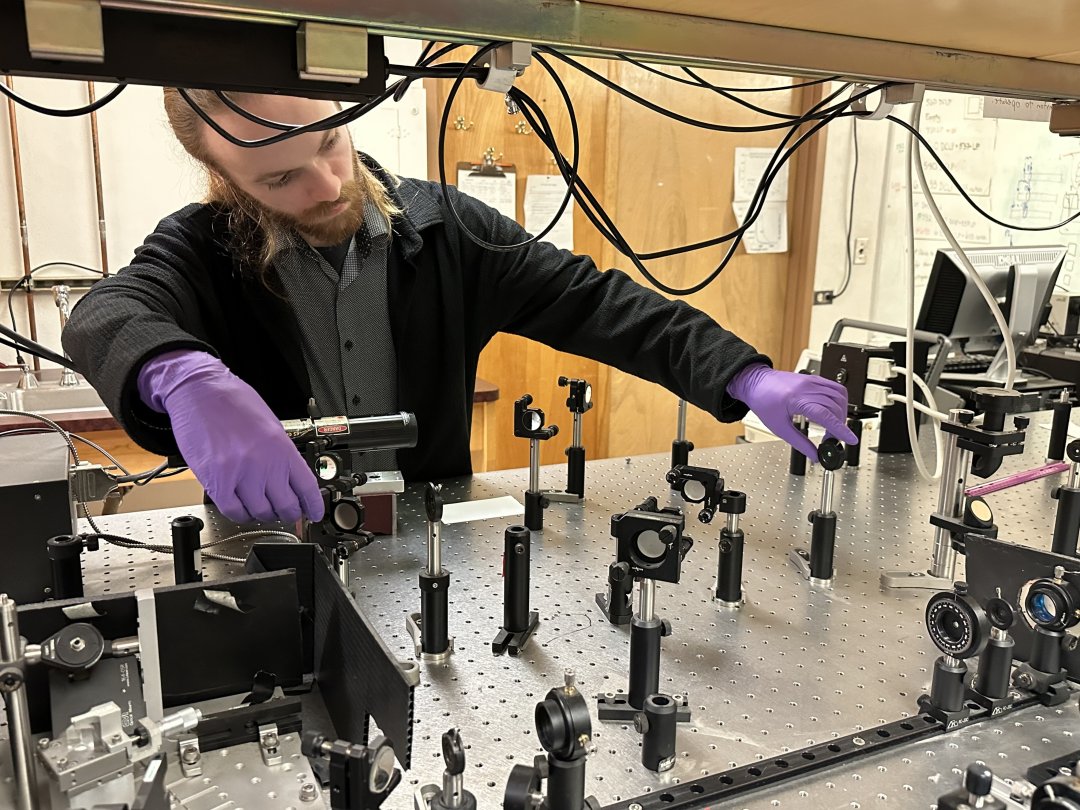
His second research project shifted from fabrication to measurement. Working with devices made by a graduate student in Ostroverkhova’s lab, he helps test how they respond to both light and electricity, a window into the underlying photophysics that govern their behavior.
At the center of the work is what happens when light hits a semiconductor. A photon can excite an electron into a higher energy state, leaving behind a positively charged “hole.” Together, the electron and hole behave like a coupled particle known as an exciton, moving through the materials as a single unit.
The lab is particularly interested in a process known as singlet fission, in which one absorbed photon can generate two excitons instead of one. In theory, that could allow devices such as solar cells or photodetectors to produce more electrical current from the same amount of light.
King’s role is to probe how these excitons interact with free charges inside working transistor devices, measuring how electrical signals change as the light intensity varies. The goal is to connect those macroscopic measurements back to the molecular-sale processes driving them and ultimately understand how to make light-responsive materials more efficient.
Much of the work happens in a dark optics lab, where lasers, mirrors and computer readouts track the behavior of devices as they are illuminated.
The most important lesson hands-on research has taught him? You don’t have to be as independent as you think you should be.
“Especially when you’re first starting out, in my opinion respectfully, you don’t really know anything. One of the preconceived notions is that you’re going to join a lab and be a rock star. You are probably going to go in there and be like ‘What is happening?” he said. “So you have to know to ask your peers for help, you’re in a lab group for a reason.”
In addition to working in a laboratory, King decided to become a learning assistant (LA). This program uses peer students to help facilitate discussions and collaborative learning in the classroom. The benefits for the students receiving the help are obvious: more opportunities to ask questions during class, clearer explanations of difficult concepts and a peer perspective that can make challenging material feel more approachable.
But the LA’s also come out of the experience stronger. King said it gave him a better appreciation of course materials.
“Also, I think being a learning assistant is good because it helps introduce people so there’s more of a connection as you’re moving up in classes,” he said.