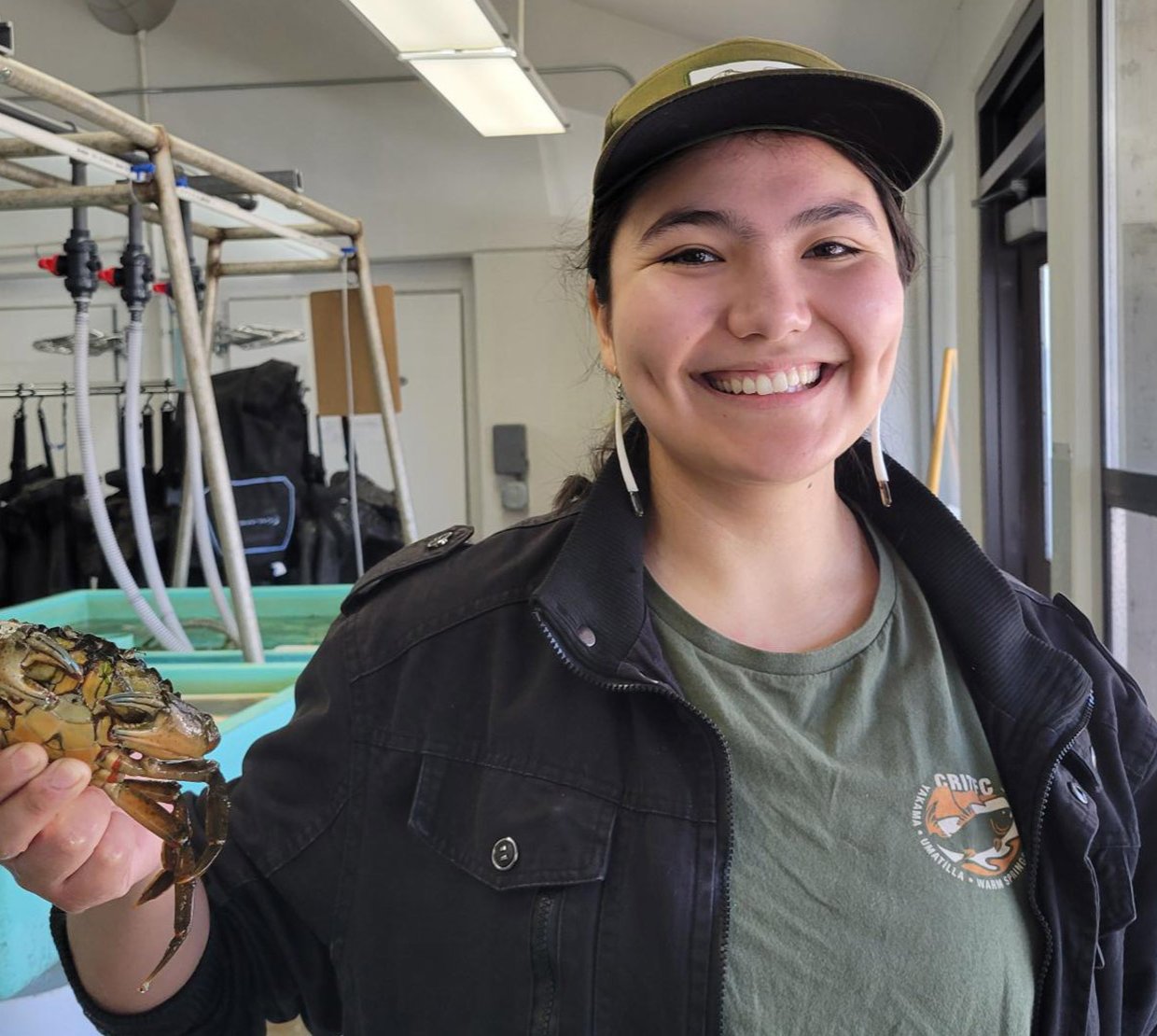
Ingram standing the Hatfield Marine Science Center wet lab, holds up a crab. She wears a CRITFIC shirt, baseball cap and beaded earrings.

National Udall Scholarhship awarded to marine biology student for leadership in tribal public policy

By Erica Martin

Ingram in the Hatfield Marine Science Center wet lab, holding an invasive European green crab (Cancer maenas) used for her group project in BI450.


Kasey Ingram, a third-year student specializing in marine biology, brings a deep and rich cultural understanding to her work in the waters. As an indigenous person of the Navajo tribe, Ingram is building a future career that connects her work to the people and cultures that have taught her what it means to be a steward of land.

This spring, Ingram was named a Udall Scholar, a national award recognizing students committed to leadership, public service and issues related to Native American nations or the environment.

Were you to go searching for Ingram right now, you would likely find the distinguished Udall Scholar knee deep in the intertidal of Newport, Ore., home of Hatfield Marine Science Center, where she’s currently taking the integrative biology coastal residency course, BI450.

The course is known for its rigor – and also for how much marine biology students love it. Spending 10 weeks living surfside, immersed in wet labs full of creatures she pulled from the intertidal herself, is Ingram’s idea of a great time.

Tools to help support Indigenous communities: biology and ecology

It was after an 8-day native rafting guide training program through Canyon Lands Field Institute in Moab, Utah, that Ingram knew she wanted to work with Indigenous communities through land or ocean conservation. The Native Teen Guide Training on the San Juan River was just a state over for the Arizona native, and the trip influenced Ingram’s career goals.

“We learned about the different environmental issues impacting Indigenous communities in the area, specifically about the water crisis,” said Ingram. “Indigenous culture is rooted in the land, and once the land gets destroyed, that culture also gets destroyed, in a way. So, hearing about that issue within my own community really motivated me to look at other Indigenous communities, as well as my own, and see how I could help.”

Ingram launched herself into undergraduate learning at Oregon State, majoring in biology with a marine biology and ecology focus and minoring in Indigenous Studies. She began constructing an academic pathway designed to prepare her for a land and ocean conservation career that could support Indigenous communities around the country. As a land grant institution, Oregon State offers all enrolled members of the 574 federally recognized Indian Tribes the in-state resident tuition rate, a policy rooted in the university’s commitment to Tribal nations and recognition of the Indigenous lands on which it was founded. Hailing from Sedona, Ariz., Ingram says she’s grateful for the policy and how it gave her access to one of the best marine biology programs in the country.

Now president of the Native American Student Association and an officer in the American Indian Science and Engineering Society at OSU, Ingram credits her willingness to get involved in the clubs and communities at Oregon State with opening doors to many opportunities. Those connections began with the munk-skukum Living and Learning Community before ever stepping foot on campus where she met many of the people she still calls friends today, and continued through the ROOTS (Reaching Our Opportunities Through STEM) program, formerly known as LSAMP (Louis Stokes Alliance for Minority Participation), a program committed to transforming the STEM experience for traditionally underrepresented students.
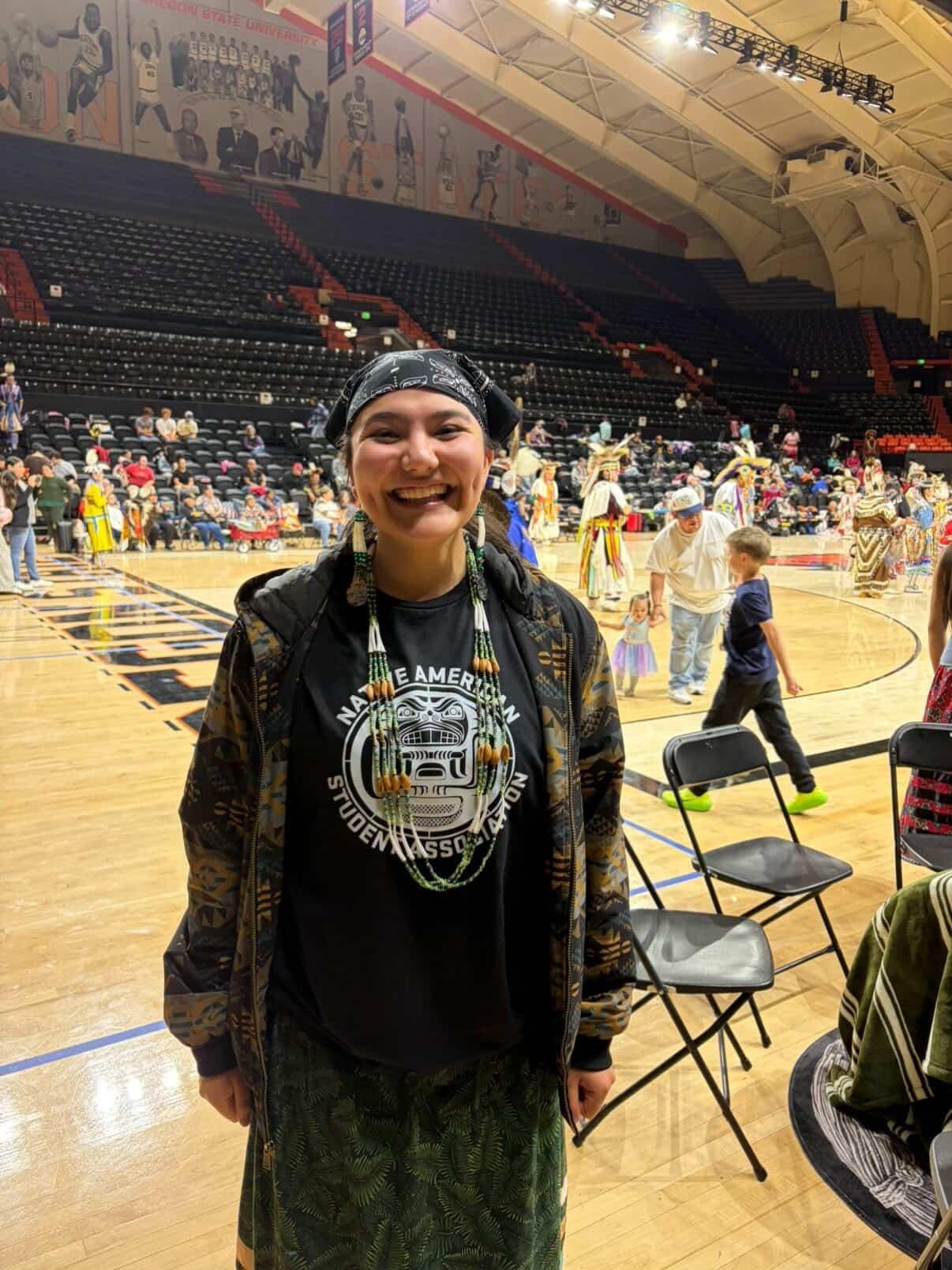
Ingram in front of a group of American Indian people in regalia during the annual łatwa ina Pow-Wow

Ingram at the 47th Annual łatwa ina Pow-Wow hosted by the Native American Student Association at Oregon State.

“I made friends by putting myself out there,” said Ingram. “I don’t get involved with the intention of getting something out of it. I invest because I really love these clubs, and they mean a lot to me. It means a lot to support my community. But, I think it pays off in ways people don’t realize. A big gift I attribute to these clubs is that my experience in them actually helped me to get the Udall Scholarship.”

Fellowships, fish and scholarships

Following her first year, Ingram was accepted into a summer internship program called the VIEW (Vanguarding an Inclusive Ecological Workforce) Fellowship through the Department of Fisheries and Wildlife, where she worked in a lab studying how salmon use olfactory cues to navigate back to where they were born to spawn.

“I love salmon. I think their life cycle is really cool. And any time I get to work with salmon, it makes me really happy because I feel like I get to give back to the tribes up here in the Pacific Northwest.”

Salmon hold deep cultural significance for many tribes along the Columbia River, making Ingram’s internship with the Columbia River Inter-Tribal Fish Commission especially meaningful. She says the organization’s work to restore salmon populations connects conservation directly to Tribal communities and traditions.

There, she worked on the water in conjunction with the Research Experiences for Undergraduates program in Oregon State’s College of Earth, Ocean and Atmospheric Sciences, launching ocean gliders: autonomous underwater vehicles used to collect ocean data, contributing directly to real-time oceanographic research.

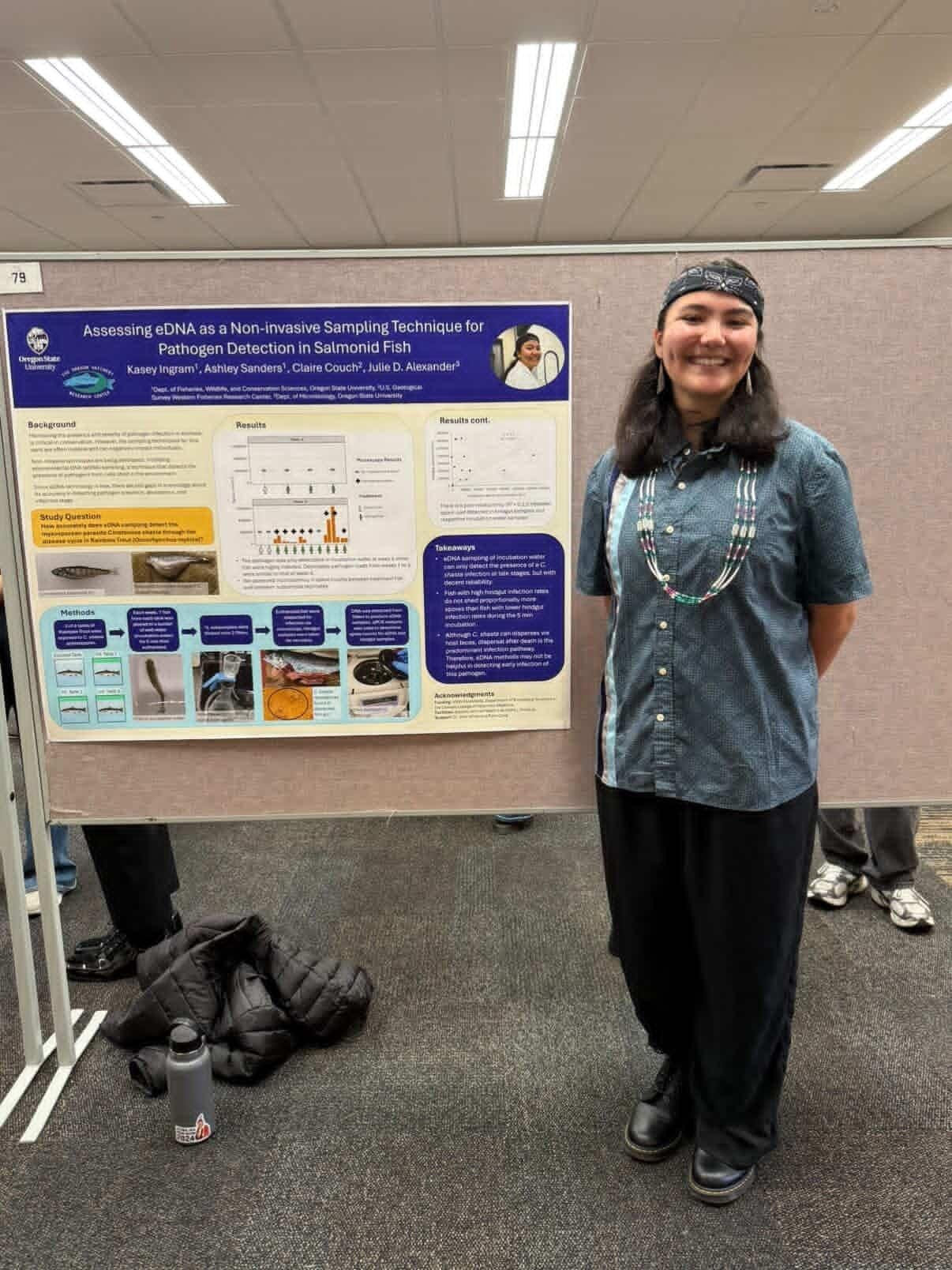
Building on her experience in the Fish Behaviorscapes Lab through the VIEW Fellowship, Ingram moved forward in her research, studying the reliability of eDNA, or environmental DNA, as a sampling method when studying pathogens in fish with Ashley Sanders (M.S. Forest Ecosystems and Society ’23) and USGS fish ecologist Claire Couch (Ph.D. Integrative Biology ’20) in the same lab. If this non-invasive sampling technique proves effective, it could improve fish and river health by improving research methods.

Ingram presents her research poster at Oregon State's 2026 Spring Symposium.

Ingram presents her research poster, "Assessing eDNA as a Non-invasive Sampling Technique for Pathogen Detection in Salmonid Fish" at Oregon State's 2026 Spring Symposium.

Recently, Ingram received the NOAA Hollings Scholarship, which provides academic support and a paid summer internship at a NOAA facility. This summer, she will work with marine biologist Jake Lasala at the Mote Marine Laboratory and Aquarium in Sarasota, Fla., studying how warming nest temperatures affect baby sea turtles and their ability to reach the ocean after hatching.

“It has implications in policy,” said Ingram. “If we can pass policies that are more climate-conscious, it would hopefully have a better impact on those sea turtles.”

Though she doesn’t see herself writing policy directly, Ingram hopes her work will help shape environmental decisions affecting Indigenous communities. She pursued the Udall Scholarship with support from OSU’s National and Global Scholarships Advising office as part of that broader goal.

“To protect Indigenous cultures, you also have to protect the lands that they come from,” she said. “A lot of conservation work that’s been done has been done on their land, but not for their communities. Their views and knowledge aren’t always taken into consideration. I think I can better implement the community’s perspectives – respect their voices and what they would like me to do.”