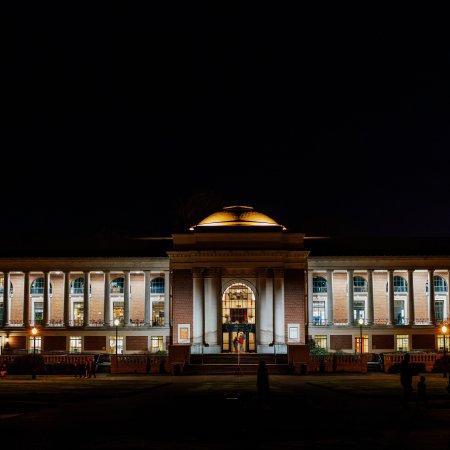
A man in a grey shirt and black coat poses for a photo in front of trees.

Kieran King, Class of '26: Preparing for a physics Ph.D. in clean-energy research

Kieran King’s interest in physics started with the big, cinematic side of the field — rockets, astrophysics and the growing clutter of satellites orbiting Earth. But as he explored new coursework and research opportunities, he became increasingly drawn to the physics behind solar cells, semiconductor materials and clean-energy technology.

When he arrived at Oregon State from Dallas, Oregon, a town roughly one-third the size of Corvallis, he planned to study political science and eventually work in environmental policy, possibly helping shape regulations around emerging space technologies.

Then he took vector calculus as an elective during freshman year.

“It was definitely the course I enjoyed the most at the time. I think that was probably a seed in the back of my head, telling me maybe there’s other types of courses I want to be engaged in,” King said.

Four years later, Kieran is preparing to move across the country to begin a physics Ph.D. at Wake Forest University in North Carolina. Instead of studying the stars, he will continue researching organic semiconductor materials that could someday improve solar energy technology and other light-responsive devices.

Through undergraduate research in physicist Oksana Ostroverkhova’s lab and semesters spent working as a learning assistant, he discovered the parts of physics that drew him in. Somewhere along the way, physics stopped feeling distant and abstract.

“I hadn’t given applied physics or down-to-earth physics the chance I should have,” he said.

A man in a lab coat works with lasers.

King works in physicist Oksana Ostroverkhova’s laboratory as an undergraduate student.

Lessons from the lab bench

After switching his major freshman year, King realized the key to succeeding in STEM is persistence.

“You’ve got to be stubborn and persistent. Some of the physics I do takes a lot of your time and it can be difficult to conceptualize or try to get through long homework assignments,” he said.

His persistence paid off. All it took was one email, and he became part of Ostroverkhova’s lab. The lab explores electronic and optical properties of organic materials using a variety of experimental techniques.

“Oksana was very outgoing and welcoming,” he said. “I think most of the physics faculty are like that. They are eager to at least meet you and talk about what opportunities they have and what it would look like to be in their lab.”

Although cold emailing can be daunting and students often keep putting it off, King recommends the opposite.

“You should get involved as soon as you can because most of the faculty want you and the longer you’re there, the better,” he said.

Ostroverhova’s lab stood out to King because of their work with organic semiconductor materials, which are alternatives to typical semiconductors made of non-carbon elements like silicon.

“I didn’t even know organic semiconductors were a thing at all. I was like ‘Woah, that's crazy. That’s not how I thought that worked.’ And I also liked the idea that the physics I could be doing as a researcher could be directly assisting sustainability goals,” he said.

Organic semiconductors are more eco-friendly because they do not require intensive resource extraction, large manufacturing footprints and numerous steps to recycle safely. Ostroverhova’s lab is working to improve the performance and stability of organic options so they are on par with inorganic versions.

King’s first project in the lab focused on fabrication work aimed at improving the photophysical properties of materials. The idea was to adapt techniques used in research on two-dimensional magnetic materials to create very small single crystals of their own compounds.

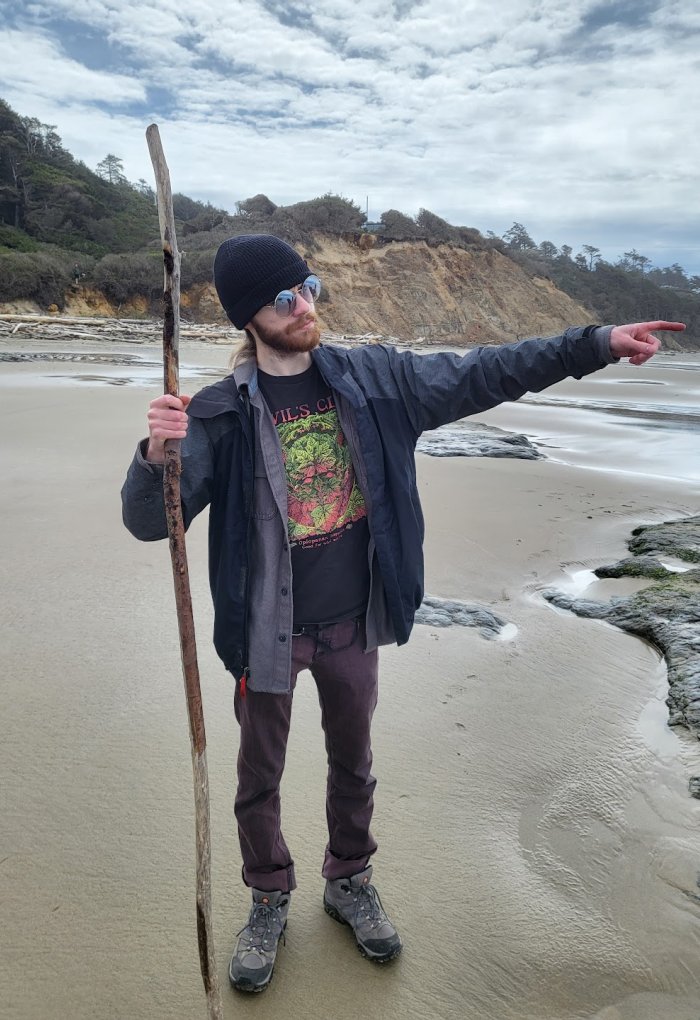
A man holds a stick on the beach.

King enjoys spending time outside on the coast.

Single crystals matter because their highly ordered molecular structure can improve conductivity and enhance how the material responds to light, both key factors in the group’s work on photophysics and potential solar energy applications.

It didn’t turn out how King hoped, but the end result was still valuable.

“I guess long story short, the project didn’t work,” he said. “But I definitely learned a lot on that project — how to plan experiments and how to critically analyze what I’m doing so that I can actually say that it didn’t work. It’s really important to be able to say, ‘I’ve done everything I think I can, it’s time to pivot.’”

Last summer King was awarded a Summer Undergraduate Research Experience (SURE) scholarship to continue his work in Ostroverhova’s lab. This program pays students to complete 10 weeks of full-time research during the summer.

"It was an amazing opportunity because it let me dive down into this and learn a lot of lessons you need to know as a scientist."

“If I needed to have another job to fill those 40 hours a week I would have gotten very little research done,” he said. “Having something like SURE is really important because it really lets you spend a lot of time doing research and developing your skills as a researcher. It was an amazing opportunity because it let me dive down into this and learn a lot of lessons you need to know as a scientist.”

His second research project shifted from fabrication to measurement. Working with devices made by a graduate student in Ostroverkhova’s lab, he helps test how they respond to both light and electricity, a window into the underlying photophysics that govern their behavior.

At the center of the work is what happens when light hits a semiconductor. A photon can excite an electron into a higher energy state, leaving behind a positively charged “hole.” Together, the electron and hole behave like a coupled particle known as an exciton, moving through the materials as a single unit.

The lab is particularly interested in a process known as singlet fission, in which one absorbed photon can generate two excitons instead of one. In theory, that could allow devices such as solar cells or photodetectors to produce more electrical current from the same amount of light.

King’s role is to probe how these excitons interact with free charges inside working transistor devices, measuring how electrical signals change as the light intensity varies. The goal is to connect those macroscopic measurements back to the molecular-sale processes driving them and ultimately understand how to make light-responsive materials more efficient.

Much of the work happens in a dark optics lab, where lasers, mirrors and computer readouts track the behavior of devices as they are illuminated.

The most important lesson hands-on research has taught him? You don’t have to be as independent as you think you should be.

“Especially when you’re first starting out, in my opinion respectfully, you don’t really know anything. One of the preconceived notions is that you’re going to join a lab and be a rock star. You are probably going to go in there and be like ‘What is happening?” he said. “So you have to know to ask your peers for help, you’re in a lab group for a reason.”

In addition to working in a laboratory, King decided to become a learning assistant (LA). This program uses peer students to help facilitate discussions and collaborative learning in the classroom. The benefits for the students receiving the help are obvious: more opportunities to ask questions during class, clearer explanations of difficult concepts and a peer perspective that can make challenging material feel more approachable.

But the LA’s also come out of the experience stronger. King said it gave him a better appreciation of course materials.

“Also, I think being a learning assistant is good because it helps introduce people so there’s more of a connection as you’re moving up in classes,” he said.

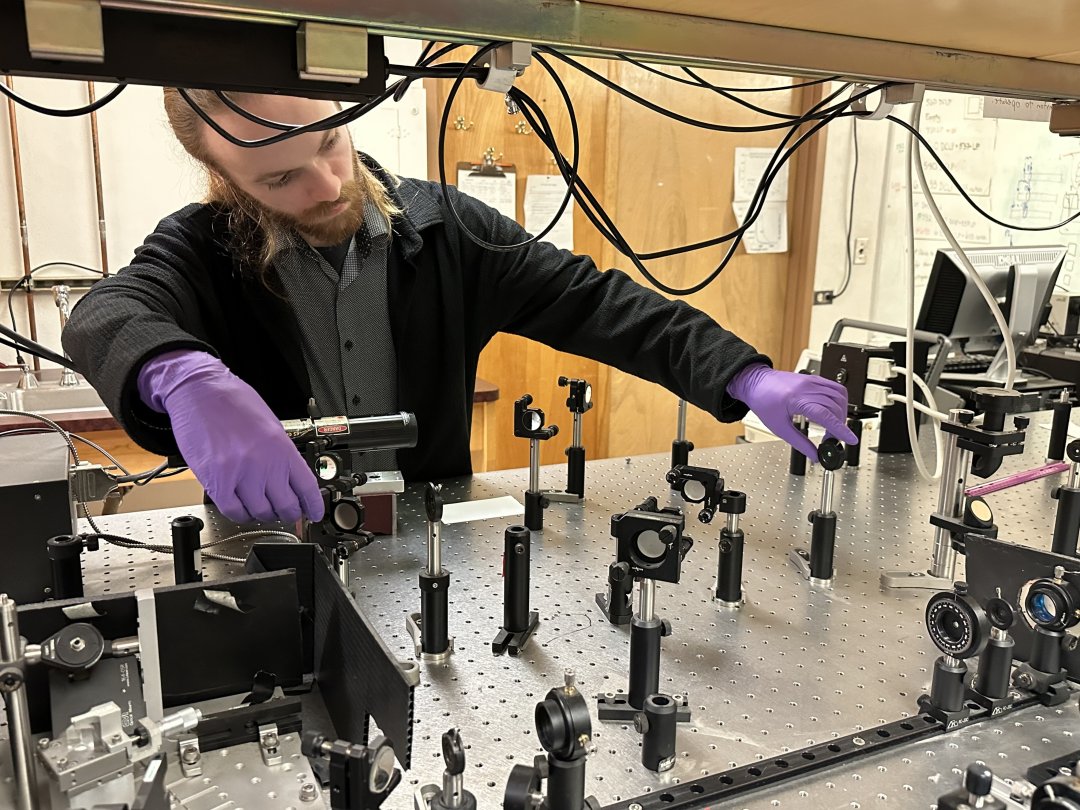
A man in a lab coat and gloves works with lasers in a laboratory.

King works in the laboratory, studying the electronic and optical properties of organic materials.

From a Corvallis lab to a Wake Forest Ph.D.

With a background in laboratory work and teaching, King is well prepared for his next big step this fall. He will move 2,775 miles across the country to begin a Ph.D. program in physics at Wake Forest University in North Carolina.

There, he will continue working on semiconductors, focusing on how to improve the conductivity of organic materials. His long-term goal is to become a professor and use physics to improve green energy options.

As he embarks on this next stage, he’s carrying more than research experience and physics knowledge with him. He’s taking the lessons he learned at Oregon State that reshaped how he sees science itself: that progress often comes through persistence, collaboration and a willingness to rethink what you thought you knew.

The student who once imagined physics only in terms of rockets and space exploration now sees it in the materials that could help power a more sustainable future.

“The reason I keep studying physics is because there is something about it that keeps challenging me in a specific way,” he said. “It keeps making me reconsider things, reconsider what I know and it pushes me to think differently.”