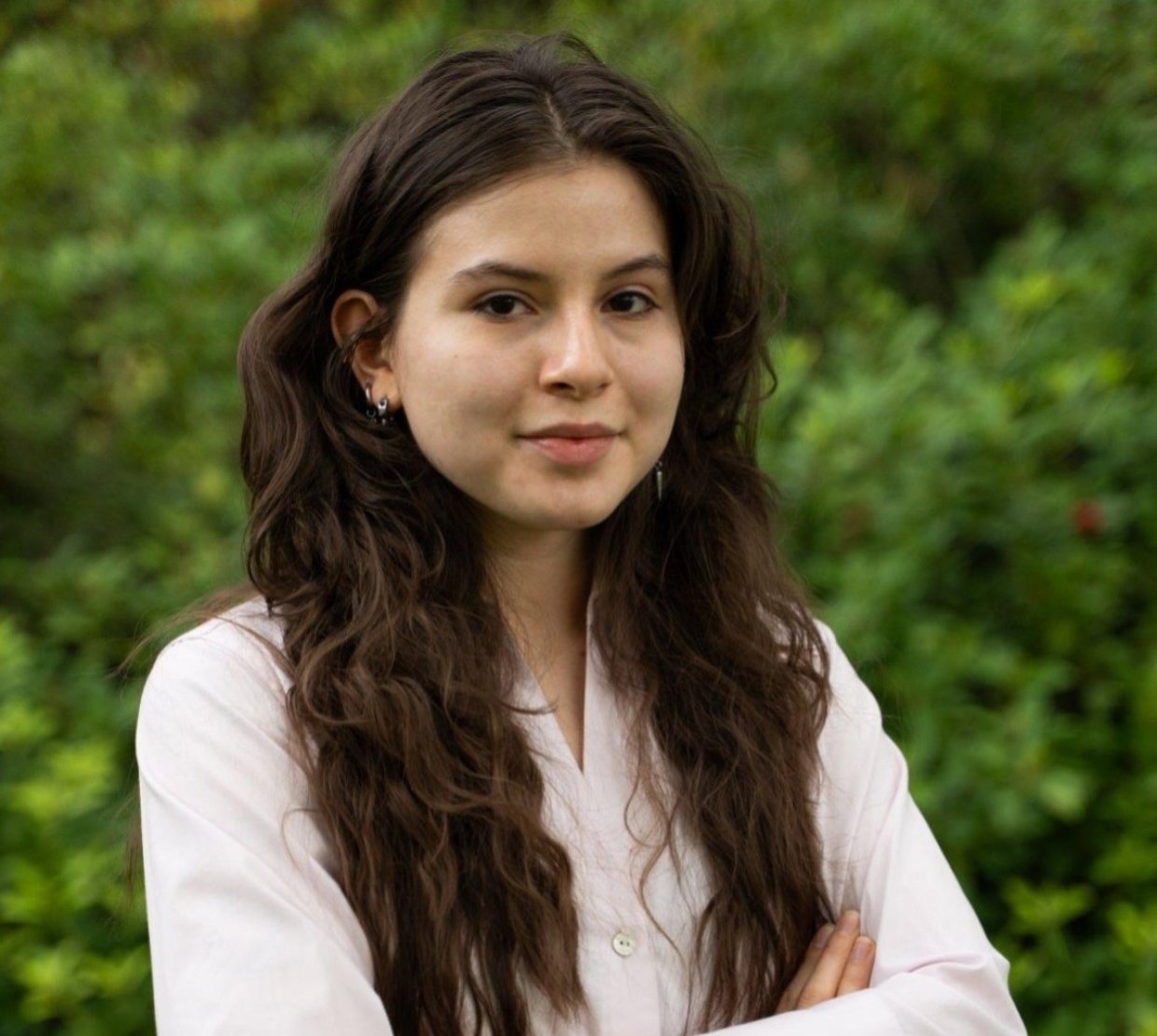
A woman in a pink shirt poses for a headshot.

Juliana Betancourt, Class of ’26: Chemistry student goes from homeschool to nanoparticle lab

By Leah Brown

Growing up, Juliana Betancourt did not think she would become a chemist.

“I was thinking I was going to be a pianist,” Betancourt said.

Betancourt is from McMinnville, Oregon, a small town about 50 miles from Corvallis. The middle child of five siblings, she was homeschooled prior to college and took piano lessons on the side. However, while she enjoyed playing music, she didn’t enjoy performing it publicly. Music school and a career of public concerts did not appeal to her.

Instead, Betancourt enrolled at Chemeketa Community College before transferring to Oregon State University, where she has been using her chemistry expertise to track microplastics and nanoplastics in the human body. She has presented her research at conferences, become a key member of her laboratory and grown into a scientist dedicated to helping others.

Tracking down nanoplastics

Microplastics are tiny specks of plastic that can — and do — end up in our bodies. Over time, light from the sun causes these microplastics to crumble into even tinier nanoplastics. Microplastics and nanoplastics are a major concern due to the harm they cause to the environment and the potential health risks they pose to humans. But nanoplastics can be quite difficult to spot inside a living organism.

“Nanoplastics and microplastics are very difficult to image in a living system,” Betancourt said. “If you want to know where they end up in your body, you need to have some sort of tracking agent.”

Historically, scientists have used fluorescent dyes to track substances in the body. The trouble with these dyes is that they disintegrate under the UV light labs use to model how microplastics turn into nanoplastics. They also have a tendency to bleed from the plastics themselves, creating free-floating dyes that can throw observers off. This means that the dyes can’t always be relied on as a tracker.

The solution? Betancourt and her team are using silver nanoparticles, which don’t degrade in light, as their tracker. This means that they can follow plastics as they move and change in the body without worrying about their tracker breaking down. “It’s not going to degrade,” Betancourt said. “It’s going to be stable for months, or years.”

This project gives researchers an important new tool in their arsenal—one that could lead to critical discoveries about how micro- and nanoplastics affect human health.

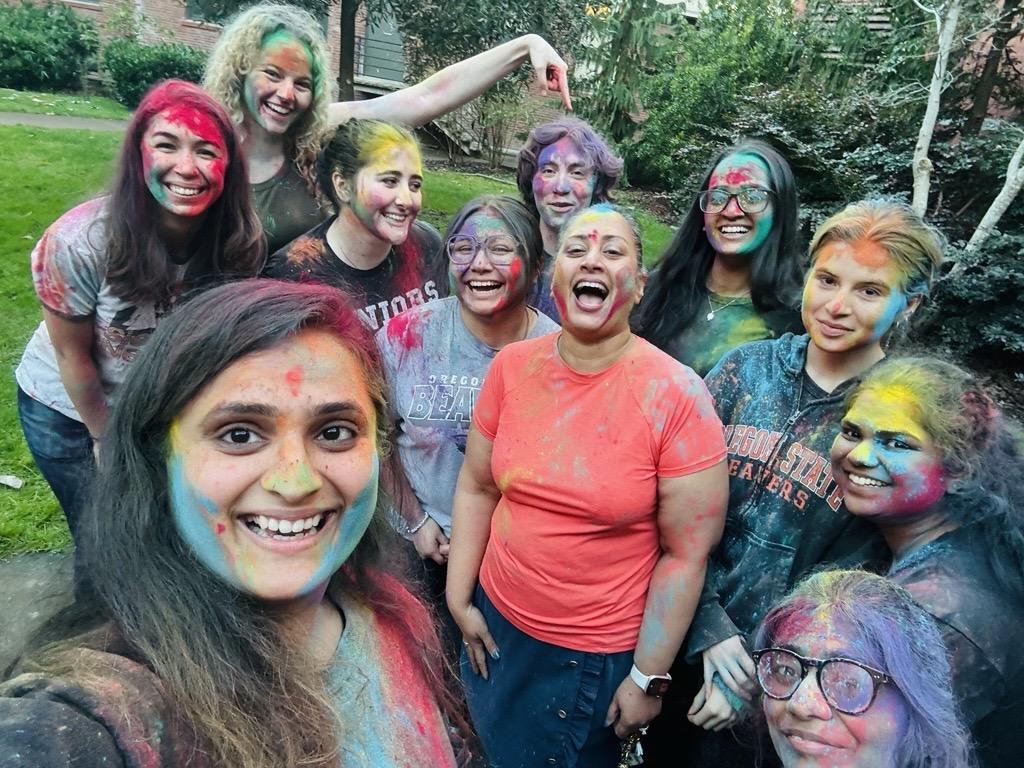
Juliana Betancourt celebrating Holi with the Mackiewicz lab.

Juliana Betancourt celebrating Holi with the Mackiewicz lab.

Arriving at Oregon State

Crafting and tracking silver nanoparticles was not Betancourt’s plan at first. At Chemeketa, she was initially planning to study engineering. But she quickly discovered a love of organic chemistry. She especially enjoyed working with her friends to take on organic synthesis.

What really appealed to her was the fundamental logic of chemistry. There wasn’t a lot of rote memorization involved; once you understood the laws, you could deduce how things worked. “That was one of the things that I liked, because I’m more of an intuitive learner,” Betancourt said.

From Chemeketa, Betancourt transferred to Oregon State, whose research capabilities, affordability and proximity to her hometown all appealed to her. Betancourt was able to get nearly all her tuition paid for through scholarships, including the Oregon Promise – a grant that supports Oregonian students attending in-state schools.

“(LURE) was a huge help, as that's how I initially got paid for doing research."

Betancourt also earned a LURE (Launching Undergraduate Research Experiences) scholarship, which offered additional financial support as she was getting established at OSU. “It was a huge help, as that's how I initially got paid for doing research,” Betancourt says.

Betancourt hit the ground running when she first arrived in Corvallis, taking 23 credits in her first term, which didn’t leave much time to relax. Over the next few years, she found a better school-work-life balance, especially when she began working in Marilyn Mackiewicz’s lab.

“When I was going to Chemeketa, I was working in a restaurant,” Betancourt said. Shortly after transferring to OSU, she got started in the Mackiewicz lab, which paid enough that she didn’t have to work outside jobs anymore.

“I don’t have to worry about non-school-related things now,” she said, “which is great, because it’s all chemistry — it’s all either research or classes.”

Although some aspects of jumping into research at Oregon State have been challenging — especially not being able to see her family as often — Betancourt has kept in touch with a small group of friends from Chemeketa who transferred with her, which has made the transition easier.

“We took gen chem and o-chem together,” Betancourt said. “So that helped a lot, because I already knew them, and we took classes here together too, which was super cool.”

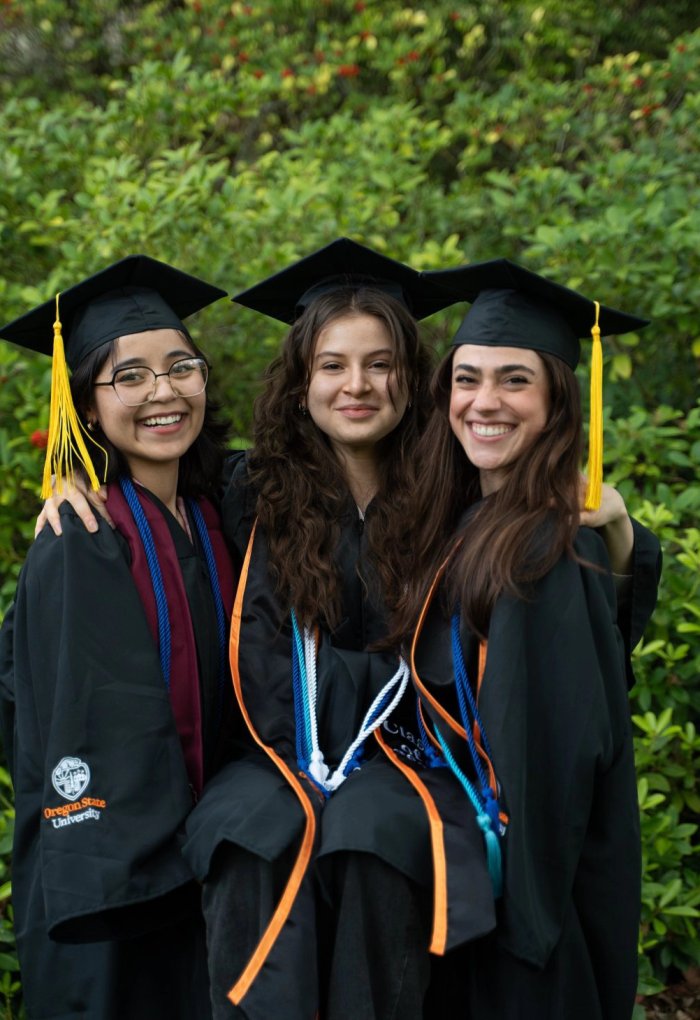
Three women in graduation regalia.

Betancourt with her friends take graduation photos.

Presenting research

Thanks to Betancourt’s skill and determination while working in the Mackiewicz lab, she’s gotten to do something few undergrads have the chance to do.

She has given talks on her research and two different international conferences: the Industry-University Collaborative Conference Program (IUCCP) and the Biomedical Engineering Society (BMES) meeting. There, Betancourt was able to discuss her research with scientists from all around the world.

IUCCP was a bit daunting, Betancourt says, both because she was still a relatively new researcher at the time and because the conference took place in Corvallis. Many of her own professors and colleagues were attending and asking her questions during her presentation.

“If there’s a faculty member asking you something, then you get nervous and question your own capabilities,” Betancourt says.

Nevertheless, Betancourt’s audience was supportive and engaging. Once she overcame her initial nerves, IUCCP was a tremendous success.

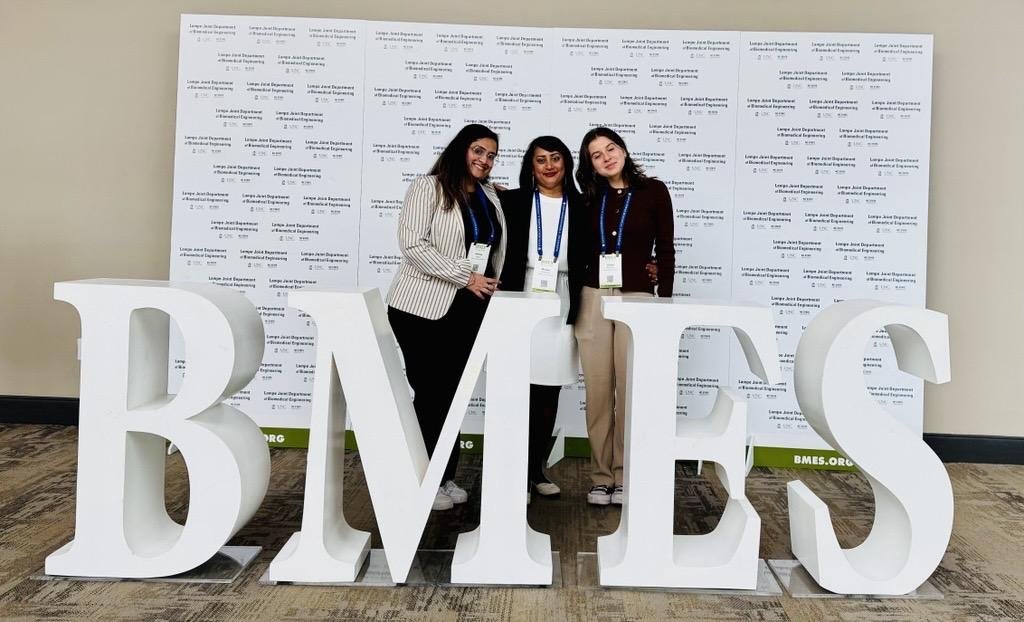
Betancourt with her Principal Investigator Marilyn Mackiewicz and grad student Anshika Nagar at the Biomedical Engineering Society (BMES) meeting.

Betancourt with her Principal Investigator Marilyn Mackiewicz and grad student Anshika Nagar at the Biomedical Engineering Society (BMES) meeting.

When she arrived at the Biomedical Engineering Society (BMES) meeting, Betancourt was much less nervous. Rather than presenting her research to an audience of chemists, she was mostly talking to biomedical engineers who were less concerned with the particulars of chemistry research. Instead, they wanted to know how Betancourt’s findings could be used in medicine.

“The questions they would ask would be less detailed about what’s going on chemically, and they’d ask about applications,” Betancourt says.

Betancourt had to take a different approach at this conference. Instead of talking shop with other chemists, she was discussing how her research could move the medical world forward.

“They didn’t know as much about the fundamentals of chemistry as a chemist would,” Betancourt says, “and explaining my research to them was a completely different experience because they focused more on the ways that my research could be utilized for medical technology.”

Lessons learned in the lab

Being in the Mackiewicz lab has taught Betancourt more than how to build nanoparticles. One of the most important things she’s learned is how to communicate effectively, both with her team members and with people less familiar with her research project.

“Communication is a very big thing,” Betancourt says. “I think communicating to someone who’s not doing the project is more difficult.” With her fellow team members, Betancourt doesn’t have to explain everything, since they already understand the project. But other people, in and out of the lab, don’t have this context. “It’s easy to make it seem like what you’ve done is not scientifically valid, unless you present it in a very detailed way,” Betancourt says.

A big part of communicating well in the lab is asking questions. “There’s really no reason not to,” Betancourt says. “It’s just much, much easier to ask someone, ‘hey, what’s the best way to run this experiment?’ rather than messing it up and wasting money and time.”

To the next horizon

Betancourt’s next stop after graduation is the University of Michigan, where she will start work on her Ph.D. There, she hopes to start work on projects with applications in medicine or renewable energy.

Betancourt wants her research to make a meaningful difference in other people’s lives. “I don’t want to just make some molecules for the heck of it,” she says. “I would like to work in a medicinal chemistry lab or work on something that’s actually going to significantly help people.”

From a homeschooled kid in a small town to a scientist whose research could transform countless lives, Betancourt has walked a long road in a short time.

“I didn’t go to school or anything when I was a child,” Betancourt says. “I didn’t have any experience with chemistry until college. To be on the brink of starting my Ph.D. in chemistry — I think that’s my biggest accomplishment.”